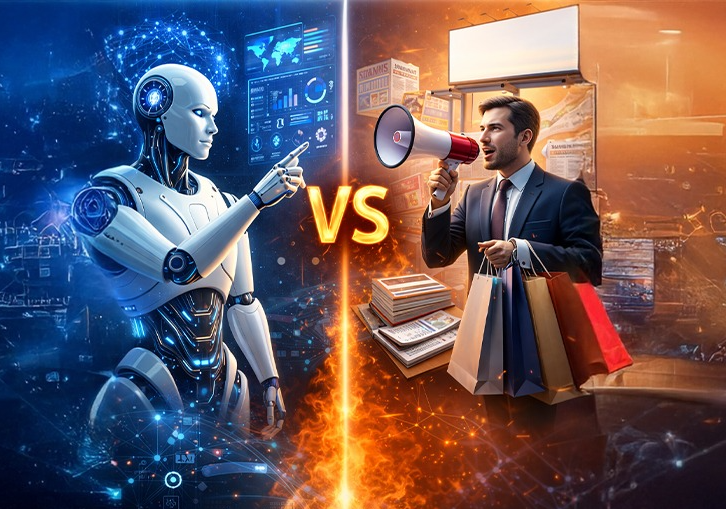
AI vs Traditional Marketing: What Actually Works Better in 2026?

FUTORICS
FutoricsThere's a conversation happening in every marketing department right now.
It goes something like this: should we keep doing what always worked, or go all-in on AI?
It's a fair question. And the answer — spoiler — is more nuanced than you'd expect.
In 2026, the debate around AI vs traditional marketing isn't about winners and losers. It's about understanding what each approach does well, where it falls short, and how the most successful brands are combining both to stay ahead.
Let's get into it.
First, Let's Define What We're Actually Comparing
When we talk about traditional marketing, we mean the tried-and-tested offline world — billboards, TV commercials, radio spots, print ads, direct mail, and face-to-face events.
These methods have built some of the world's most iconic brands. There's a reason Coca-Cola still runs Super Bowl ads.
On the other side, AI marketing 2026 refers to using artificial intelligence to automate, personalize, and optimize every part of your marketing — from how you reach people to what you say to them and when.
We're talking about AI marketing tools that can predict customer behavior, write personalized emails, optimize ad spend in real time, and even generate creative content.
What Traditional Marketing Still Gets Right
Let's be fair to the old guard. Traditional marketing vs digital marketing isn't a clean knockout.
Traditional approaches still hold real power in specific contexts:
• Brand trust and familiarity: A well-placed print ad in a premium magazine carries a different kind of credibility than a digital banner.
• Reaching older demographics: Not everyone is glued to a screen. Newspapers and radio still reach millions.
• Local community presence: A billboard in the right location speaks directly to a geographically concentrated audience.
• Tangible, sensory impact: A beautifully designed brochure or a live event creates physical memory — something digital simply cannot replicate.
The limitation? Traditional marketing is expensive, slow to adjust, and nearly impossible to measure precisely.
You run a TV spot and you hope it works. With AI marketing 2026 — you know exactly what works, in real time.
What AI Marketing Does That Traditional Simply Cannot
This is where things get exciting.
Artificial intelligence in marketing doesn't just speed things up. It fundamentally changes what's possible.
"AI doesn't just make marketing faster. It makes marketing smarter — personalizing every touchpoint at a scale no human team ever could."
Here are the capabilities that are genuinely transformative:
1. Hyper-personalization at scale — AI can serve different messages to millions of users based on their individual behavior, preferences, and purchase history. No traditional approach can match this.
2. Predictive analytics — Marketing automation platforms powered by AI can predict which leads will convert, which customers are about to churn, and what your next best campaign topic should be.
3. Real-time optimization — AI marketing tools adjust your ad bids, targeting, and creative in real time — constantly improving performance without human intervention.
4. 24/7 customer engagement — AI chatbots and email automation mean your brand is responsive and present at every hour, every day.
5. Content generation — AI assists in creating blog posts, social media captions, email subject lines, and ad copy — dramatically reducing production time.
The Numbers Behind Digital Marketing Trends 2026
Numbers don't lie. Here's what the data is showing this year:
• Businesses using AI-driven personalization report up to 40% higher email open rates
• Marketing automation reduces campaign launch time by an average of 60%
• Companies leveraging AI analytics see a 25–30% improvement in lead conversion rates
• AI-powered ad optimization reduces cost-per-acquisition by up to 35%
These aren't future projections. These are digital marketing trends 2026 already playing out in real businesses.
So... Who Wins? AI or Traditional?
Neither. Both. It depends.
Here's the honest truth about AI vs traditional marketing:
If you're a luxury brand selling high-end products — you probably still want that editorial spread in a premium publication. The prestige is real.
If you're a fast-growing e-commerce brand or a service business trying to scale — AI is not optional anymore. It's the engine.
The brands winning in 2026 have figured out the hybrid playbook:
• Use traditional marketing for emotional brand storytelling and prestige positioning
• Use artificial intelligence in marketing for data, personalization, automation, and measurement
• Let each approach amplify the other rather than compete with it
A Practical Hybrid Framework
Not sure where to start? Here's a simple way to think about it:
Stage 1 — Brand Awareness
Lean traditional: PR, print, events, community presence. Build emotional recognition.
Stage 2 — Consideration & Nurturing
Go AI: Personalized email sequences, retargeting ads, content marketing powered by AI tools.
Stage 3 — Conversion
Go AI: AI chatbots, predictive lead scoring, automated follow-ups, dynamic landing pages.
Stage 4 — Retention & Loyalty
Blend both: AI-powered loyalty programs + personal touchpoints like handwritten notes or exclusive events.
The Futorics Philosophy
At Futorics, we don't believe in abandoning what works. We believe in making it work harder.
Our approach to AI vs traditional marketing is grounded in one question: what does your customer actually need to feel connected to your brand?
Sometimes that's a beautifully crafted piece of print collateral. Sometimes it's a perfectly timed automated email. Often — it's both.
The brands that will define their industries in the next decade aren't choosing sides. They're choosing strategy.
Stop guessing and start growing. Futorics helps brands build intelligent marketing strategies that blend the best of AI and traditional approaches. Talk to our team at Futorics — your next breakthrough starts with one conversation.