Brand Guidelines Explained: What Every Growing Business Should Include

FUTORICS
FutoricsWhy Growing Businesses Need Brand Guidelines
Every business starts with a spark: a name, a logo, a few colors that feel right. In the early days, the founder personally approves everything, so the brand feels consistent almost by default. But as the team grows, new hires join, freelancers come on board and marketing spreads across websites, social media, packaging, and presentations, that consistency starts to slip. One designer uses a slightly different blue. Another writes in a casual tone while the sales team sounds formal. Slowly, the brand your customers recognize becomes fragmented.
This is where brand guidelines come in. Brand guidelines are a documented set of rules that explain how your brand looks, sounds and behaves across every touchpoint. They act as a single source of truth, so anyone creating something for your business, whether an intern or an external partner, can do it correctly without guessing. For growing businesses, they are not a luxury. They are the foundation that protects your reputation as you scale.
What Are Brand Identity Guidelines?
The terms are often used interchangeably, but there is a useful distinction. Brand identity guidelines focus on the tangible, visible side of your brand: your logo, colors, typography, imagery and layout principles. Broader brand guidelines go further, covering your mission, values, personality and communication style as well.
Think of brand identity guidelines as the visual and verbal toolkit and brand guidelines as the full playbook. A strong document combines both, so people understand not only what your brand looks like but also why it looks and sounds the way it does. That context helps teams make smart decisions in situations the rulebook never anticipated.
Start With Your Brand Foundation
Before any design decisions, a good guideline document begins with strategy. This section explains who you are as a business and gives every creative choice its purpose. It should include your mission, vision and core values, along with a clear description of your target audience and what sets you apart from competitors.
Your brand positioning statement belongs here too. It is a concise explanation of what you offer, who it is for, and why it matters. When a designer or copywriter is unsure whether an idea fits, the foundation section lets them check it against your core purpose. Without it, even beautifully designed guidelines can feel like decoration rather than direction.
Logo Usage Rules
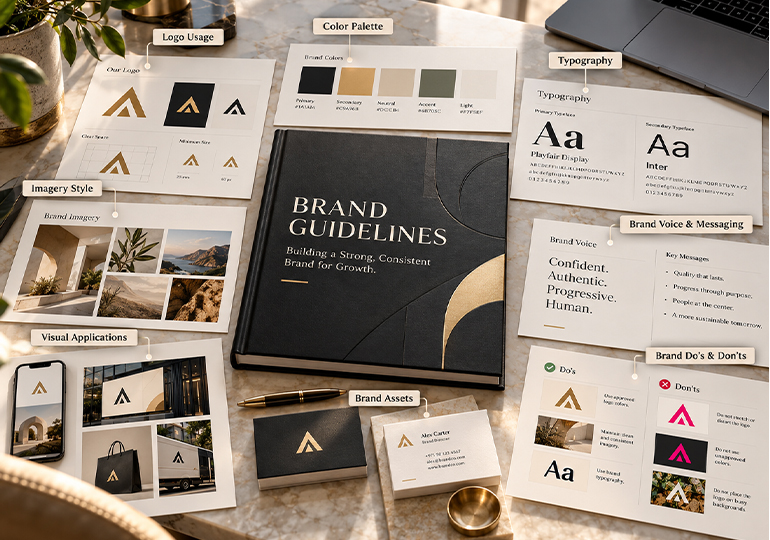
Your logo is the most recognizable asset you own and it is also the one most often misused. A thorough guideline document should show the primary logo along with any approved variations, such as horizontal, stacked, icon-only and single-color versions. It should also define clear space around the logo, minimum sizes for print and digital use and acceptable backgrounds.
Just as important are the “don’ts.” Stretching the logo, changing its colors, adding effects or placing it on cluttered images can weaken brand recognition quickly. Showing visual examples of incorrect usage removes ambiguity and saves countless hours of revisions. These are the kinds of branding standards that keep your identity sharp and professional wherever it appears.
Color Palette and Typography
Color is one of the fastest ways people recognize a brand, so your guidelines should define your palette precisely. List primary and secondary colors with exact values for every format you use, including HEX and RGB for screens, and CMYK and Pantone for print. Add guidance on how colors should be balanced, such as which one dominates and which is reserved for accents or calls to action. Accessibility matters here too. Contrast ratios should be specified so your content stays readable for everyone.
Typography deserves the same care. Specify your primary and secondary typefaces, along with fallback fonts for situations where your chosen fonts are unavailable. Define the hierarchy for headings, subheadings, body text, and captions, including sizes, weights and spacing. Consistent type creates a rhythm that audiences subconsciously associate with your brand.
Imagery, Iconography and Graphic Elements
Photographs, illustrations, icons, patterns and graphic shapes all contribute to how your brand feels. Your guidelines should describe the style of imagery that represents you, whether bright and candid, polished and editorial or bold and abstract. Include examples of what works and what does not, along with notes on subject matter, composition and color treatment.
Icons and illustrations should follow clear rules for line weight, corner style and level of detail. When these elements are consistent, they combine with your logo, colors and typography to form a cohesive visual identity system, a connected set of components that work together rather than a collection of separate assets.
Voice, Tone and Messaging
Visuals tell only half the story. How your brand communicates is just as important and this is where many guidelines fall short. Define your brand voice with a few descriptive traits, such as confident, approachable and clear, and explain what each one means in practice. Then outline how your tone adapts across situations, from a celebratory social post to a customer support reply or a formal proposal.
Include practical guidance on vocabulary, grammar preferences and phrases to use or avoid. Sample taglines, boilerplate descriptions and key messages give writers a ready reference. When your voice is consistent, customers feel they are speaking with one trusted company rather than several disconnected teams.
Applications Across Real-World Touchpoints
Rules only become useful when people can see them applied. A strong guideline document shows how your corporate identity design comes to life across real materials: business cards, letterheads, email signatures, social media templates, website layouts, packaging, signage and presentation decks. Mockups and annotated examples help teams replicate the look correctly without needing a designer on hand for every task.
Consider including templates that team members can use directly. This turns your guidelines from a reference document into a working tool, which dramatically improves adoption across departments.
Make Your Guidelines Easy to Use and Easy to Update
The best guidelines are the ones people actually open. Keep the structure clear, the language simple and the layout scannable. Many businesses now host their guidelines as a digital resource with downloadable assets, so logos, fonts and templates are always a click away. Assign someone to own the document and be clear about who approves exceptions.
Remember also that your business will evolve. New products, new markets and new platforms will emerge, so review your guidelines at least once a year. A living document that reflects where your brand is today will always serve you better than a polished PDF that gathers dust.
Why Work With a Branding Agency
Creating guidelines that are both strategic and practical takes experience. A professional Branding Agency brings an outside perspective, market insight, and the design expertise to turn your vision into a cohesive system. Rather than just producing a logo and a color palette, an agency helps you define your positioning, build a distinctive identity, and document it in a way your whole team can use confidently.
For growing businesses, that partnership often pays for itself. Consistent branding builds recognition, recognition builds trust and trust is what turns first-time buyers into loyal customers. Investing early in well-crafted brand guidelines also saves the cost and confusion of rebranding later.
Build a Brand That Stays Consistent as You Grow
Brand guidelines are more than a design document. They are a promise that your business will look, sound and feel the same at every touchpoint, no matter how large your team or audience becomes. By including a clear foundation, logo rules, color and typography standards, imagery direction, voice guidelines and real-world applications, you give your brand the structure it needs to scale with confidence.
Ready to Create Your Brand Guidelines?
At Futorics, we help growing businesses build strong, consistent brands, from identity design to complete brand guidelines your team can use every day. If you are ready to strengthen your brand and make it stand out, we would love to hear from you.
Contact Futorics today to discuss your project and get started. Visit Futorics and reach out to our team for a conversation about your brand.